
Finding Hempstead Residents by Record
There is no official master roll of every person in Hempstead. Start with the question instead. A parcel search can identify the real estate tied to an address. The Nassau County Clerk index can show the parties to a recorded deed. A library directory can place a household at an address in a particular year. New York voter lookup is intended for a person checking registration, while court and vital-record systems have their own limits. Each source proves a small, dated fact rather than a complete biography.
Keep the Village of Hempstead, the Town of Hempstead, Nassau County, and the postal city separate. The same street may trigger records from more than one of those governments. A Village-created permit belongs with Village offices; a Town-created permit must be pursued through the Town. If a result does not name its creating agency, treat it as a lead and confirm the jurisdiction before making a request.
- Enter a complete address in the Nassau Land Records Viewer and record the parcel address and section, block, and lot.
- Use that identifier in the County Clerk land-record route when the question concerns a deed, mortgage, or other recorded instrument.
- For a historical household, check the library, New York State Library directory microfilm, yearbooks, and archives for the right year.
- Use a court index or an eligible vital-record route only when its purpose matches the question and the access rule permits it.
- When an online result is missing, send the creating office a precise FOIL request with the record type, date range, address or identifier, and desired format.
Hempstead Resident Records Offices
The Village Clerk is the local starting point for Village minutes, notices, local legislation, archives, FOIL routing, and many permit-related files. The Nassau County Clerk is the controlling custodian for recorded land instruments. County Assessment maintains the parcel and tax-map context. The State Board of Elections runs the voter-status lookup, while the courts control their own case files. These offices keep records for different public purposes, so a name in one record does not establish present residence.
Nassau County Assessment
240 Old Country Road, 4th Floor
Mineola, NY
516-571-1500
Village Clerk and State Elections
99 James A. Garner Way
Hempstead, NY 11550
516-478-6202
Hempstead Parcel Search Fields
The Nassau Land Records Viewer is the useful first screen when the starting point is an address. Its visible search controls include section, block, lot, house number, street name, Town, and ZIP, followed by a captcha and Search button. The research notes advise omitting directionals and street suffixes when an exact street search fails. A partial street may work. The screen does not display an owner-name field, so the result should be treated as parcel context and then checked against the Clerk record where ownership matters.
| Section, block, lot | Parcel identifier that helps match assessment and Clerk research |
|---|---|
| House number and street | Address route, with normalized variations for search |
| Town and ZIP | Useful filters, but not proof of Village jurisdiction |
| Result context | Tax map, sketch, sale, district, and related parcel links |
The Nassau Land Records Viewer begins with those address and parcel fields.
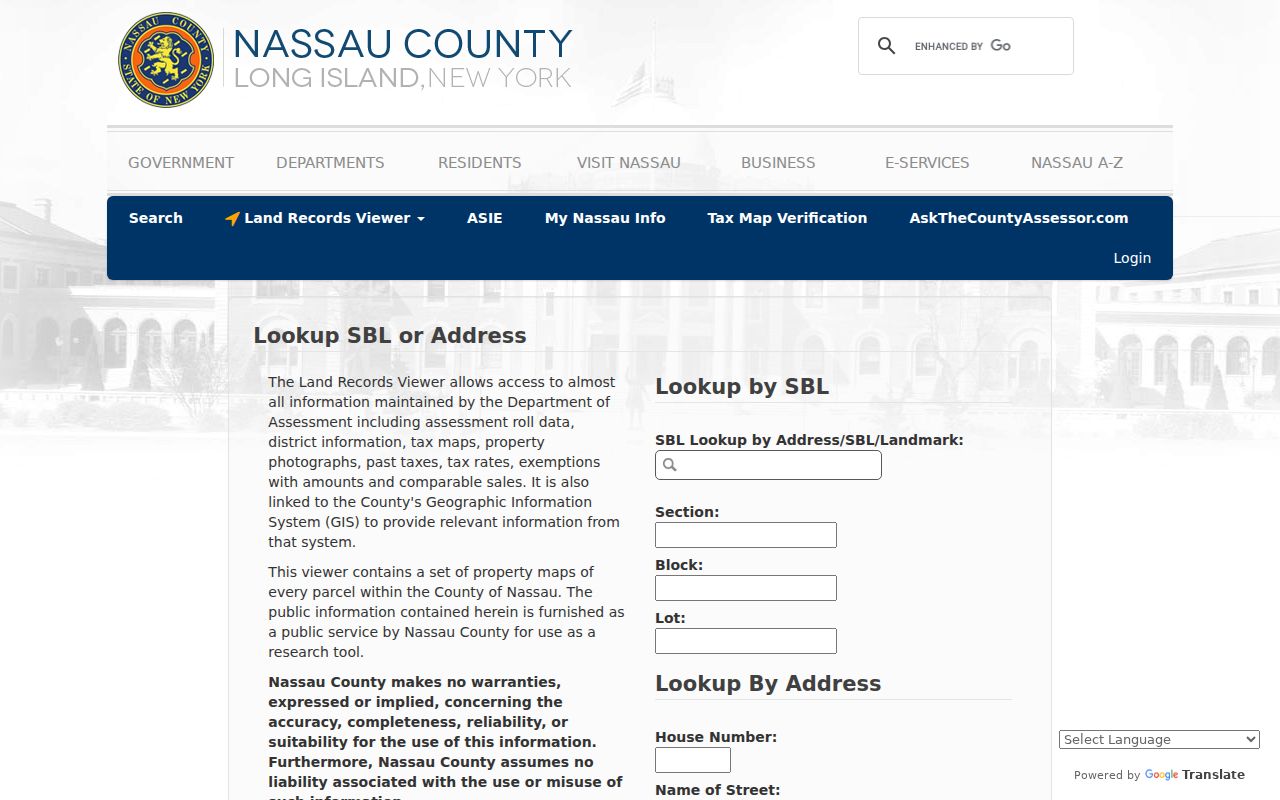
Its layout shows why an address must be normalized before moving from a map result to a recorded land document.
Hempstead Village and Town Records
Hempstead is an incorporated Village inside the Town of Hempstead. That distinction changes the first call. The Village Clerk serves as records-management and records-access officer, holds Board materials and local archives, and routes Village FOIL requests. Village SmartGov has public notices and reports/documents alongside account functions for applications and inspections. The Town Clerk, Town Registrar, Town Building Department, and Town ViewPoint portal handle Town-created material. A Town portal result is not automatically a Village record.
The Town of Hempstead online permit center is a separate route for Town permit submissions, status checks, inspections, prior permits, messages, and printing.
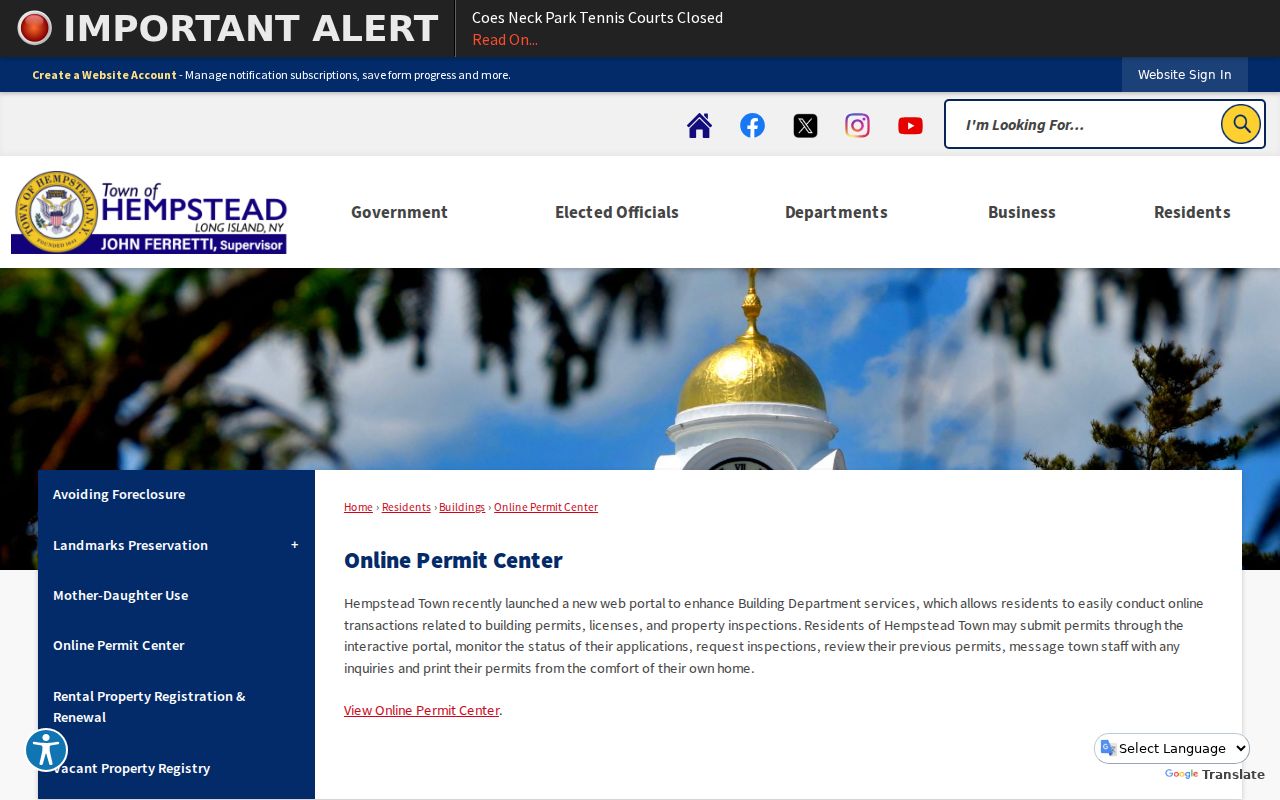
Its public access route is useful only after confirming that the address and creating authority are within the Town system rather than the incorporated Village.
A July 2026 appellate decision involving Town permit files noted the public ViewPoint route and a public kiosk as access channels. That is a reason to check the named creator and the relevant portal before assuming a permit is counter-only. Older or absent material may still require a focused request to the office that created it.
Hempstead Deed Indexes by Era
Land research has two overlapping time boundaries in Nassau County. The historic official-record repository advertises searchable material from 1840 through 1982, including direct and reverse index books and searchable document text. The County guide separately notes an electronic land database since July 1992. Those statements describe different tools, not a promise that every gap is online. When an address trail crosses the changeover, search the historic repository and the current official-record route, then review the document image.
Direct and reverse indexes can surface the parties to a recorded transfer. They do not establish who lived at the property. The Clerk's current operating procedure also documents mail, delivery, drop box, e-recording, and in-person channels for land work and document requests. For a certified record or title question, contact the Clerk rather than treating a free index as final proof.
Record term: A grantor transfers an interest and a grantee receives it. An index points to a record; the document image is the item that must be read.
Current Hempstead Resident Sources
Current records are often address, parcel, transaction, or case indexes, not household lists. The value of the Hempstead residents directory is knowing the boundary of each source. A land record documents a recorded party and parcel. The assessor tool supplies parcel context. A professional-license search can confirm state-issued license status, not a home address. A voter-status tool is not a roster for redistribution. Use the result type and date as part of every note.
| Source | Who It Lists | Keeper | Access |
|---|---|---|---|
| LRV parcel result | Parcel address, SBL, tax and map context | Nassau Assessment | Public research tool |
| Land-record index | Grantor, grantee, instrument, date | Nassau County Clerk | Index and record route |
| Voter status lookup | Individual registration question | New York elections | Limited administrative use |
| Village directory | Departments and public contacts | Village of Hempstead | Online directory |
| Library local history | Historical names, places, editions | Hempstead Public Library | Reference and special collections |
For a one-name problem, cross-checking a dated directory entry, a properly scoped official index, and an address is more reliable than relying on one broad result. Separate what each record can confirm from what it cannot.
Hempstead Residents Directory Evidence
Official records and commercial search products serve very different purposes. A commercial result can combine outdated entries or merge people with the same name, while an official record is limited to the event or transaction the agency created. Neither one establishes every fact about a person. For a family-history, heir, address-history, or civic question, start with the source that created the relevant record and preserve its date and identifier.
| Official parcel or deed source | Supports a dated parcel or recorded-instrument fact; does not prove present occupancy. |
|---|---|
| Library directory or yearbook | Supports a historical printed association; does not update itself after publication. |
| Commercial search category | May be incomplete or blend identities; verify any lead with the creating agency. |
Use the official custodian for a copy, correction, access limitation, or question about what the record means. That route also keeps sensitive details within the context and safeguards the agency intended.
Hempstead Court and Vital Limits
A case index and a vital-record application should never be used as a broad resident roll. WebCivil Local accepts party, attorney, judge, court, case-type, year, status, and appearance filters, but sealed cases are absent. WebCriminal has separate case-identifier, defendant, and calendar routes and generally emphasizes active or future-appearance material. A no-hit is not proof that no case existed. Court clerks handle certified copies and access questions for their own files.
Village birth records are also a creator-specific route. The Village Registrar limits them to births within its jurisdiction and requires an eligible applicant, a signed application, and identification. Fax and email are not accepted for the application described in the research. For older family-history work, the State genealogy route has eligibility windows and produces an uncertified copy. A generic FOIL request does not bypass those rules.
The New York civil case search illustrates the different filters that a court index uses.
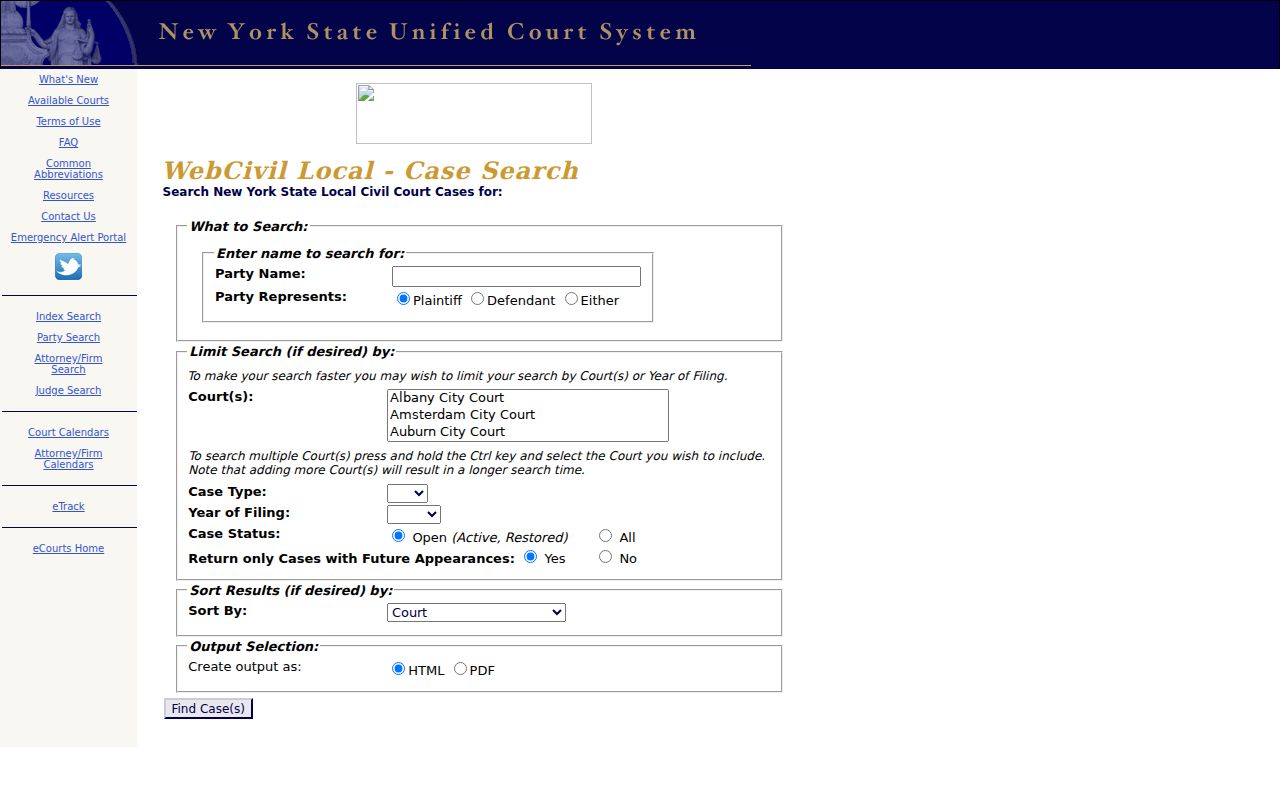
Reading the court, case type, year, and status together is safer than treating a matching name as a conclusion.
New York Voter Lookup Boundaries
New York's voter lookup asks for last name, first name, date of birth, county, and address information. It is designed for a person checking registration and election administration, not for building or republishing a block list. For historical election structure or broader files, the Board of Elections FOIL procedure requires a truthful elections purpose and provides a distinct administrative path. Keep voter information in its narrow context and do not use it to fill gaps in a parcel or directory record.
The official New York voter lookup shows the individual-status inputs used by the state tool.
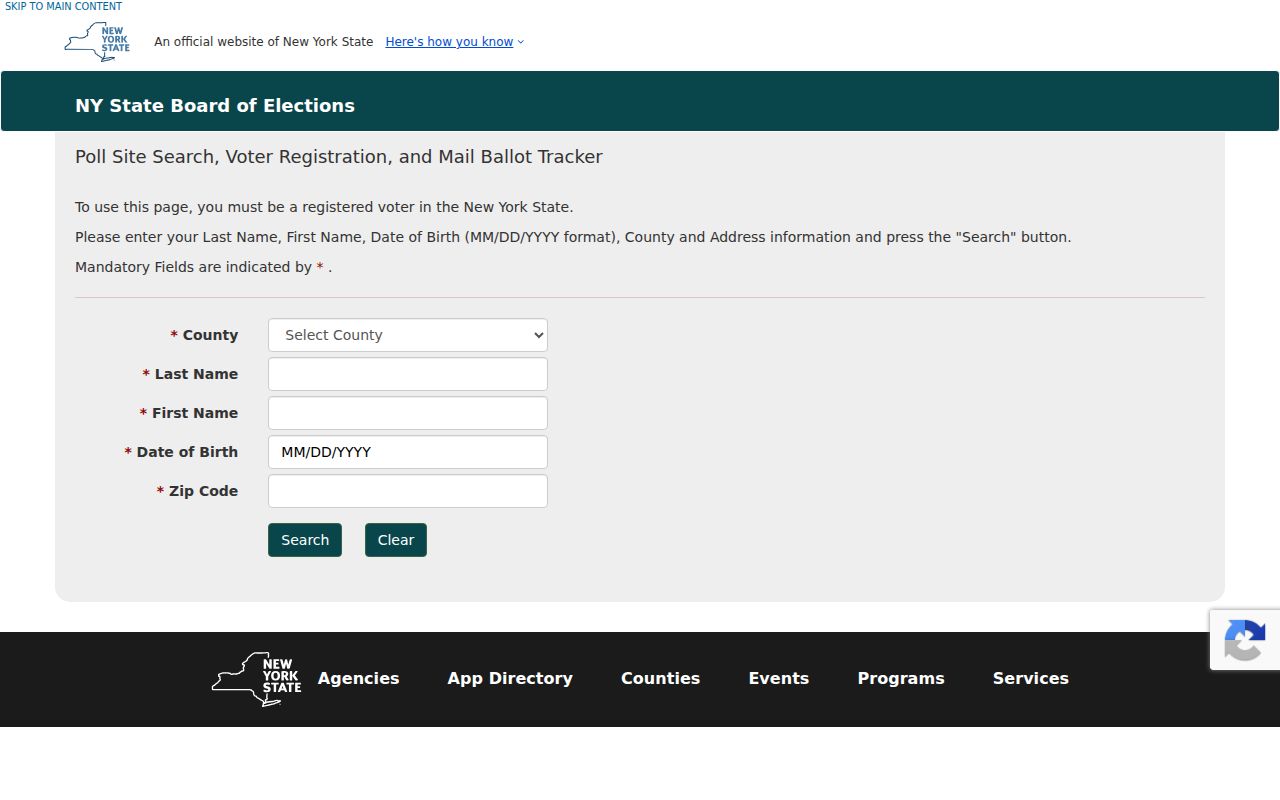
Those fields are a reminder to use the service for its stated election purpose and to avoid publishing sensitive voter data.
Hempstead Records Withheld or Redacted
FOIL is New York Public Officers Law Article 6. Agencies can provide, deny, or acknowledge a request and give an approximate completion date, but they also may redact personal privacy and safety information. Village birth records and indexes are expressly not FOIL/public. Court files can be sealed or confidential. The Address Confidentiality Program protects a substitute mailing address for eligible survivors, and DMV personal information has separate statutory protection. A postal ZIP does not authorize reconstruction of a protected address.
Use records lawfully. Check a source with its custodian, minimize personal details in notes, and never use a record to stalk, harass, or harm anyone.
Hempstead Archive Starting Points
Historical work can continue beyond one directory shelf. The Town Clerk describes its office as keeper of records reaching back to 1644, although Town custody does not make every old Hempstead item a Village record. Hempstead Public Library, the Village Historian, the Nassau County Historical Society, Hofstra's Long Island Studies Institute, and the New York State Archives offer separate leads. The State Archives combines finding aids, catalog records, digital collections, name indexes, and archived state websites.
The Village's 2025-2026 inactive-records project, listed with a $24,106 State Archives grant, signals records-management work. It does not mean that inactive material is already digitized or freely searchable. Ask the custodian about the specific collection, year range, and access channel instead of assuming an online search is complete.
Historical Hempstead Resident Directories
Hempstead Public Library is the practical local starting point for older residents, with a Long Island History Collection, yearbooks, local books, and appointment-only special collections. The New York State Library lists Hempstead directory microfilm for 1901/02, 1903/04, 1915/16, and 1930/31. A printed entry can associate a person with an address and occupation at the time of publication; it cannot prove who occupies that address today.
The historical collection detail belongs on the Hempstead city directories page. Pair each directory year with the edition, page, address spelling, and source location. That simple log makes it possible to test an old household against maps, photographs, census material, and later recorded instruments without merging people who share a name.
Hempstead Record Access Channels
Online search is only the first channel. The Village Clerk can route Village records, minutes, archives, local legislation, and FOIL requests. The Town Clerk and Town Registrar have separate custody for Town-created archives, licenses, and vital-record matters. Nassau County Clerk handles recorded land instruments and county court-related records, while County Assessment answers parcel and tax-map questions. Court clerks provide the case-specific route for a certified disposition or an online index that does not show a final outcome. Each office may require an identifier, date range, identification, a fee, or a written request.
Historical research has its own fallback chain. Hempstead Public Library offers the local-history collection and reference support, with special collections available by appointment. The library's yearbook material and Historic Hempstead photographs provide time-specific context. New York State Library directory microfilm, the New York Public Library catalog, Nassau County Historical Society, Hofstra's Long Island Studies Institute, and the New York State Archives provide additional shelves, catalogs, and finding aids. A library or archive no-hit should be recorded as a searched collection and date range, not as proof that a person or house history does not exist.
For a current office connection, use the official Village directory or the custodian's published contact route. For a historical question, preserve the full citation: organization, collection, edition or record type, page or identifier, year, and the date of access. That recordkeeping helps distinguish a source you reviewed from an index lead you still need to verify.
Hempstead Copy Requests and Fraud Alerts
When a record is not indexed online, request it from the office that created it. A useful FOIL request names the agency, record type, date range, address, parcel or file number, preferred electronic or paper format, and a willingness to pay any lawful copying charge. Nassau County e-Services points users toward agency-specific access routes rather than one universal record form. A vital record, court file, or protected item follows its own access process even when a general FOIL route exists.
For land records, Nassau County warns about misleading paid deed-copy or protection mailings. The County Clerk is the source for official copies and offers a free Property Fraud Alert email service. An alert does not prevent a filing and is not a title search, but it is a practical prompt to review a new recorded document through an official channel. Do not respond to an unfamiliar payment link or caller; compare the request with the Clerk's published contact information.
Hempstead Addresses Need Two Checks
A street address has both a mailing identity and a civil identity. USPS formatting is useful for mail, but it cannot decide whether a parcel is inside the incorporated Village, the Town, or an adjacent postal area. The county parcel result supplies another part of the answer through its Village or Town context, tax-map links, and SBL. The postal city, school district, fire district, and court jurisdiction can follow separate boundaries. Record the source date with each finding because portal and boundary data can change.
That distinction matters most when records conflict. A property record that says Hempstead may concern a Town area or postal designation rather than the incorporated Village. Start again with the complete address, normalize its street spelling for the search tool, capture the parcel result, and then verify the creating agency. For a whole address chain, the Hempstead street directory follows the parcel, deed, permit, and map route in more detail.
Hempstead Name and Address Variants
Dense local records reward careful searching. A person can appear with a middle initial, a shortened given name, a changed surname, or a different street form in a directory, court index, or deed record. The Village also has a substantial multilingual population, so a reasonable spelling variant may be worth checking without making assumptions about an individual's background. Keep the original search string beside each variation. That simple note makes it possible to repeat the search later and explain why two similar results were treated as different people.
For an address, preserve the way it appeared in the source, then record the normalized version used in the portal. When a record is not located, say that it was not located in the searched source and date range. Check a direct or reverse index, a different year span, an offline counter file, library microfilm, and archive finding aids before concluding that the record is absent.