
Hempstead Resident Lookup Record Paths
No single official database holds every Hempstead resident. Each record was built for its own purpose. A Nassau parcel result can anchor an address, but ownership says nothing about who actually lives there. A deed names recorded parties, not residents. Historic directories, yearbooks, census entries, newspapers, and photo captions can tie a person to a street. That link holds only for the stated year, though. Treat every hit as one link in an evidence chain, and then chase down an independent record that agrees on the name, address, date, or case number before calling it settled.
| Record path | What it can confirm | Official or holding route | Access limit |
|---|---|---|---|
| Parcel and assessment data | Parcel location, SBL, district context, and roll details | Nassau LRV or AROW | It identifies a parcel, not an occupant. |
| Historic directories and yearbooks | A printed association with an address or school year | Library, archive, or digitized collection | Record the source and publication year. |
| Court index | A party name, court, and procedural entry | New York eCourts | Sealed and other excluded matters do not appear. |
| Vital or genealogy route | An eligible civil-record request or historical copy | Village Registrar or NYS genealogy | Eligibility and record-specific rules apply. |
| Professional license search | License status and a listed practice or business address | New York DOS | A listed address is not a home address. |
Pick the source closest to your question. Family-history work often starts with a dated directory entry and a yearbook. A parcel question starts with LRV instead. Then the County Clerk holds the recorded instrument itself. For identity, insist on at least two records pointing to the same individual rather than a loose pile of similar names.
Verifying a Hempstead Resident by Name
A name search should narrow the field, not pile up maybes. Keep the spelling exactly as each record shows it. Note middle initials and date ranges along the way. An index hit is not the same thing as an image or certified document, and when a name is common, an address, filing year, parcel identifier, or court number beats another broad search.
- Write down the full name, any known address, and the date range. Search LRV or AROW by address or SBL to establish parcel context, without treating the result as proof of occupancy.
- Check a dated directory, yearbook, census record, or historic image caption for an independently stated name-and-address association. Preserve the collection name and year.
- Search the appropriate court index with name variants and the court, case type, and year filters. Capture the case or summons number before asking a clerk about a file.
- Use the custodian’s own vital, probate, or license route only when its eligibility rules fit the question. Request a certified copy only when the creating office directs it.
Parcel maps show lots, not households. Longer address histories need dated sources. The Hempstead city directories page gathers year-by-year collections, making it a stronger first stop than any attempt to infer a current household from a parcel map.
Note: Record a negative result as not located in the source and date range searched, rather than as proof that no record exists anywhere.
Hempstead Court Index Filters
Hempstead Village Court sits at 99 James A. Garner Way, a separate local court from Nassau County District Court. WebCivil Local handles local civil case research. Search options cover Party, Attorney, and Judge names. Set party representation to Plaintiff, Defendant, or Either. The form also narrows by court, case type, filing year, and open or all case status. Future-appearance selection, sorting, and HTML or PDF output round out the options. An index entry is procedural, not a verdict. The WebCivil Local party-search screen shows the filters a searcher can set before running a name.
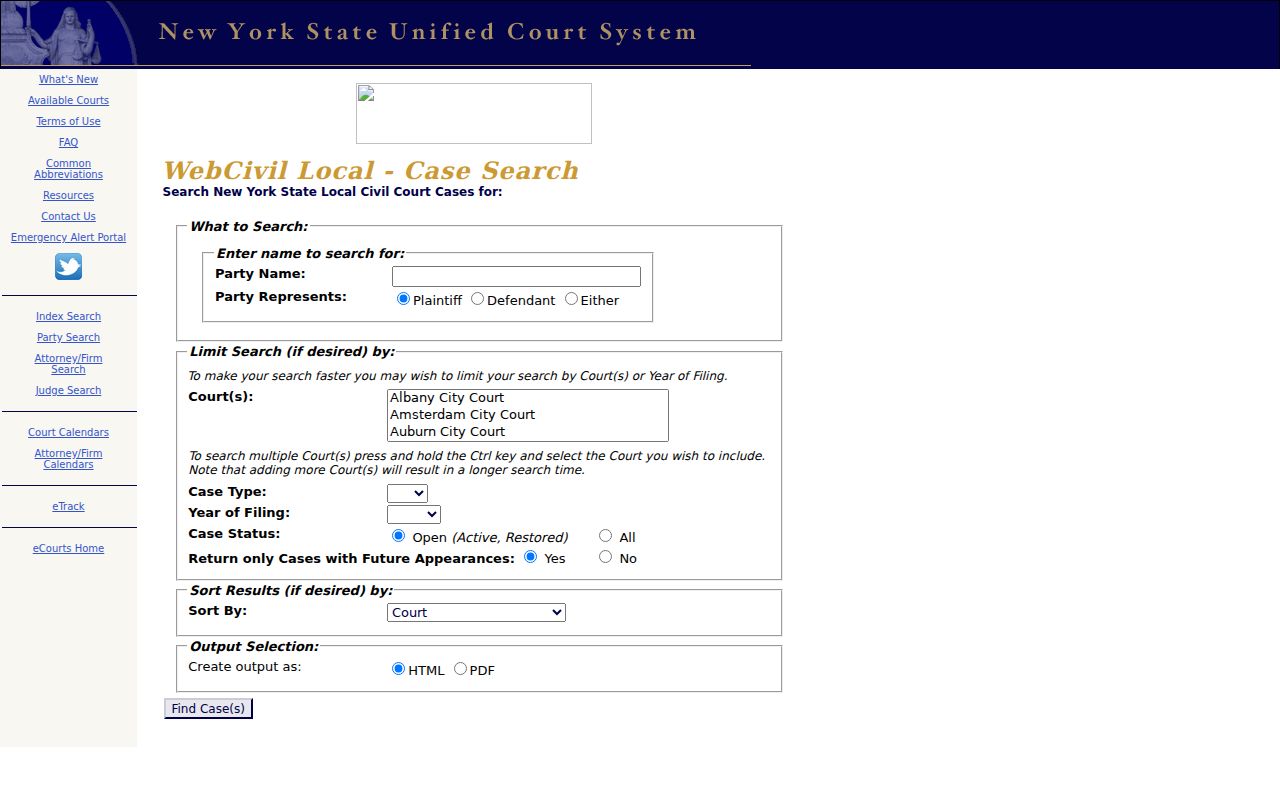
Court and year filters cut down false matches. Keep the case number with your search notes. Sealed cases are excluded, so the result set never amounts to a complete file inventory.
Hempstead Court Case Results
WebCriminal works differently and carries its own limits. Its case-identifier search needs a case or summons number plus a court. Defendant search takes a first and last name, or a corporation, with a court selection. Calendar search uses court, part, judge, and date. The system mainly tracks active or future appearances. That focus leaves gaps. Sealed cases, youthful-offender matters, CPL 160.55 matters, no-future-appearance records, certain infractions or violations, warrant-only matters, and treatment-only matters may all stay hidden. An absence proves nothing about past cases. A result, when one appears, can list the defendant name, case or summons number, next appearance, court, date, part, judge, birth year, incident or arrest dates, related numbers, charges, motions, and appearance history. Read those fields as an index inventory. A clerk, not the search screen, controls access to any official disposition or certified court document.
Hempstead Record Terms
Record systems favor short labels. Those labels can make two very different stages of a case look alike, which matters the moment a name surfaces in a Hempstead search result.
- Docket
- A court’s running record of a case and its filings, appearances, and scheduled activity. The docket number helps the clerk identify the file.
- Index
- A searchable list of entries, such as names, dates, and case numbers. An index can confirm that an entry was created, but it may omit the underlying document.
- Image
- The scanned or electronic document itself. Review it for the exact parties, date, and any redactions before relying on a record.
- Certified copy
- A copy issued or certified by the custodian under that office’s procedures. It is different from a screen result or an informal download.
Keep the claim modest. The chain holds best when the index entry, the underlying image where one exists, and the custodian's response all back the same narrow statement.
Hempstead Vital Record Routes
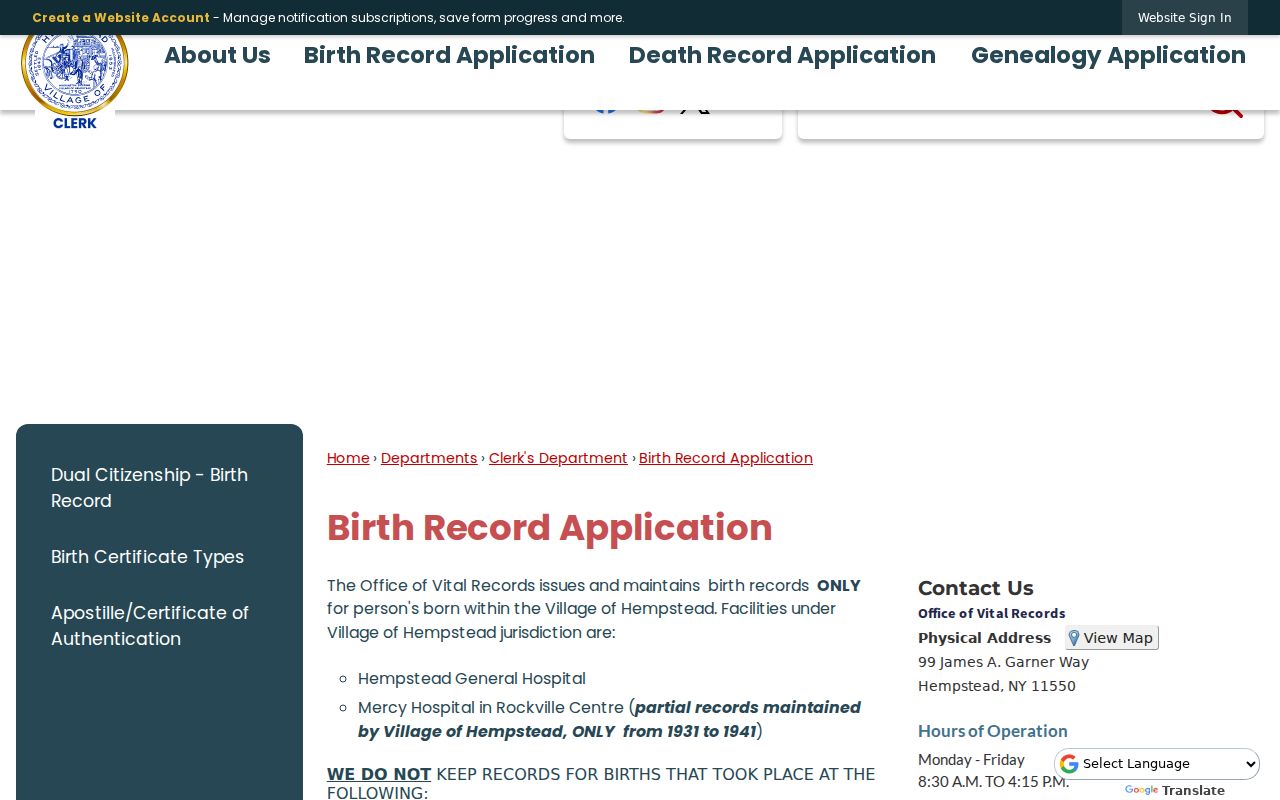
Village birth records fall outside FOIL entirely. The Village issues them only for its own births. The route runs through the Registrar, in person, with a completed form, a handwritten signature, and valid photo identification. Fax and email are not accepted. Third parties need proper authorization. That makes the route creator-specific, and a general records request cannot bypass it. The Village birth-record application sets out the eligibility and identification route for this narrow class of records.
Historical research takes a different road. New York runs a genealogy copy program. It supplies uncertified copies under its own windows: births at 75 years with the person known deceased, deaths and marriages at 50 years under their stated conditions. State processing can run past eight months. Eligible probate and genealogy routes help too. They can establish family relationships without the work turning into a broad personal file.
Note: A Village record belongs to Village jurisdiction, while Town and state routes carry separate forms, eligibility tests, and processing practices.
Hempstead Voter Status Limits
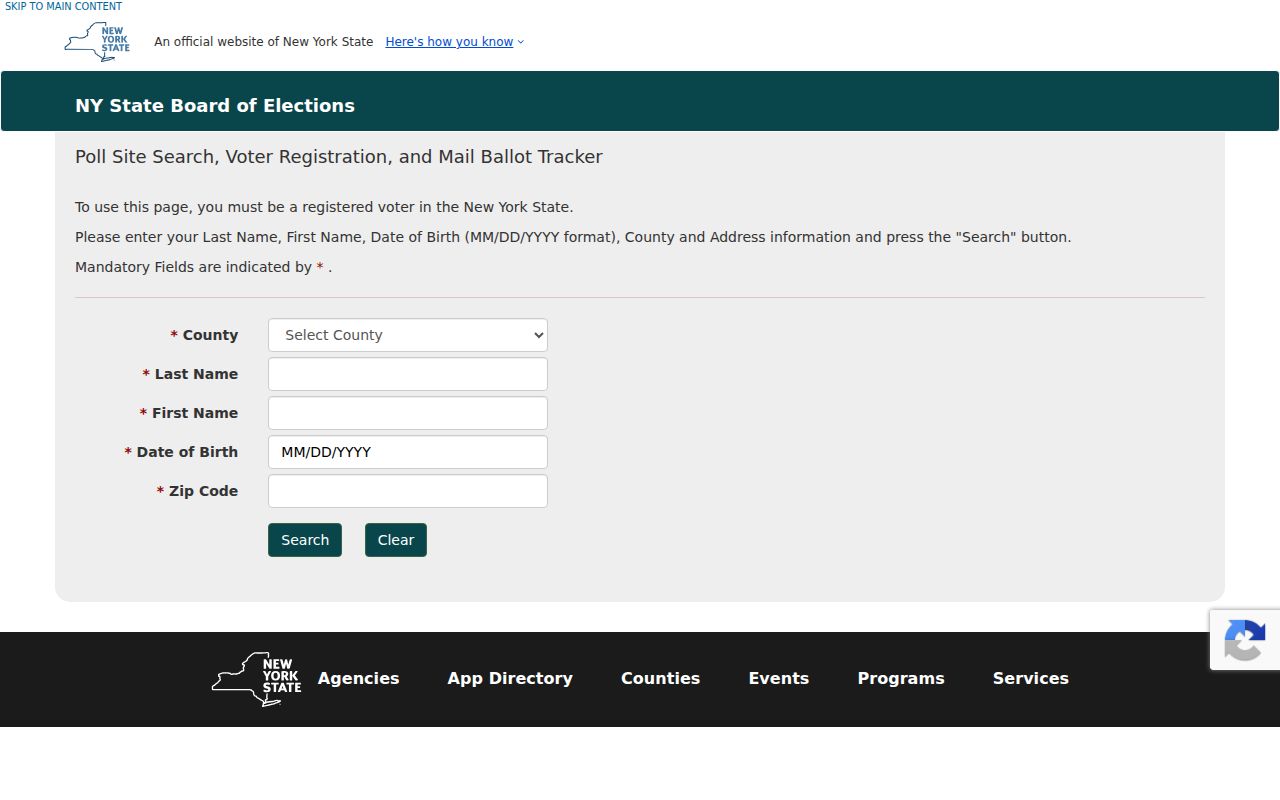
New York runs its voter lookup for personal use. It answers a resident's own registration question. It is not a Hempstead residents directory or any kind of public roll. The form asks for last name, first name, a date of birth in MM/DD/YYYY format, county, and address information. Search will not return anything before those fields are filled. Confidential registrations and update timing can both change what comes back. Treat results as a single status answer. Do not copy them into a list or rebuild another person's address from them.
The New York voter lookup only accepts the identifying fields its public form shows. A Hempstead resident lookup through it stays narrow by design.
Election material held by an agency follows a different path. A FOIL request to the New York Board of Elections must state a truthful election purpose under Election Law §3-103(5). Name the election, the district, the year range, and the record category. Say whether inspection or copies are wanted. That route is deliberately narrow. It was never meant to serve as a substitute for publishing voter rolls.
Hempstead License Status Checks
A state license search can corroborate a credential or a business listing. The New York Department of State form takes last name, first name, license type, county, city, and ZIP Code. It also offers an all-license-types option. Which fields come back depends on the profession. Read a result as a dated status check only. It is not an endorsement. A listed practice address is not proof of where someone lives.
The search earns its keep when one person must be separated from another. The other person carries the same name spelling in state records. It cannot establish a present Hempstead residence. When the premises matters, first confirm where the address sits. Is it in the incorporated Village, or in an unincorporated Town area? Confirm that before drawing any conclusion.
Hempstead Records Privacy Lines
New York FOIL, Public Officers Law Article 6, §§84–90, lets agencies redact records for personal privacy reasons. It also lets them withhold records for safety reasons. Courts can also seal or keep confidential matters out of view. Full dates of birth, signatures, phone numbers, account numbers, medical details, and protected addresses deserve that same caution. That holds even when one source exposes part of the record. Republishing them is not justified. A sliver appearing somewhere does not change that. Cite a record identifier, the source date, and the custodian's limitation instead.
Lawful personal use. Use official Hempstead records for careful personal research, family history, or a records question. Never use a result to stalk, harass, intimidate, or expose a protected person.
New York's Address Confidentiality Program gives eligible survivors a substitute mailing address. The real address stays confidential except through the legal channels the law allows. The program does not erase every older record, though. No one should try to rebuild or publish protected location information from past residents data. No one should use any other trail to do so either. For a correction, redaction, or access limit, ask the agency that created the record. Ask it in the first place.
Hempstead Historical Identity Checks
Older sources carry weight when they bring their own dates. The Hempstead Public Library keeps local-history material and yearbooks. The New York State Library holds Hempstead city-directory microfilm for 1901/02, 1903/04, 1915/16, and 1930/31. Set a printed name, address, and year beside census or archive evidence. Then label the finding as historical. A photograph caption or yearbook entry proves only what that one item shows.
Village Court records, Village vital applications, and historical shelves each serve a different purpose. Keeping those lanes separate makes any name search sharper. It also stops a dated association from hardening into a claim about a person living in Hempstead today.